AI・テクノロジー
The Shock of Japan's New Domestic AI Company | The Full Picture of 8 Companies and ¥1 Trillion Led by SoftBank
機械翻訳 / Machine-translated
A
AI Friends
2026年4月26日・31分で読める

機械翻訳 / Machine-translated
@aifriends
AI Friends(https://aifriends.jp)のクロスポスト公式アカウント。AIツールの紹介・使い方・できることを、中学生でもわかるやさしい日本語で届けます。
"When it comes to AI in Japan, it's just ChatGPT or Claude, right? Do we really need domestically produced AI?" — Have you ever heard that sentiment? On April 12, 2026, a massive project launched that answers that question head-on.
Eight of Japan's most representative companies — led by SoftBank and joined by NEC, Honda, Sony Group, and others — came together to establish a new company: "Japan AI Foundation Model Development."
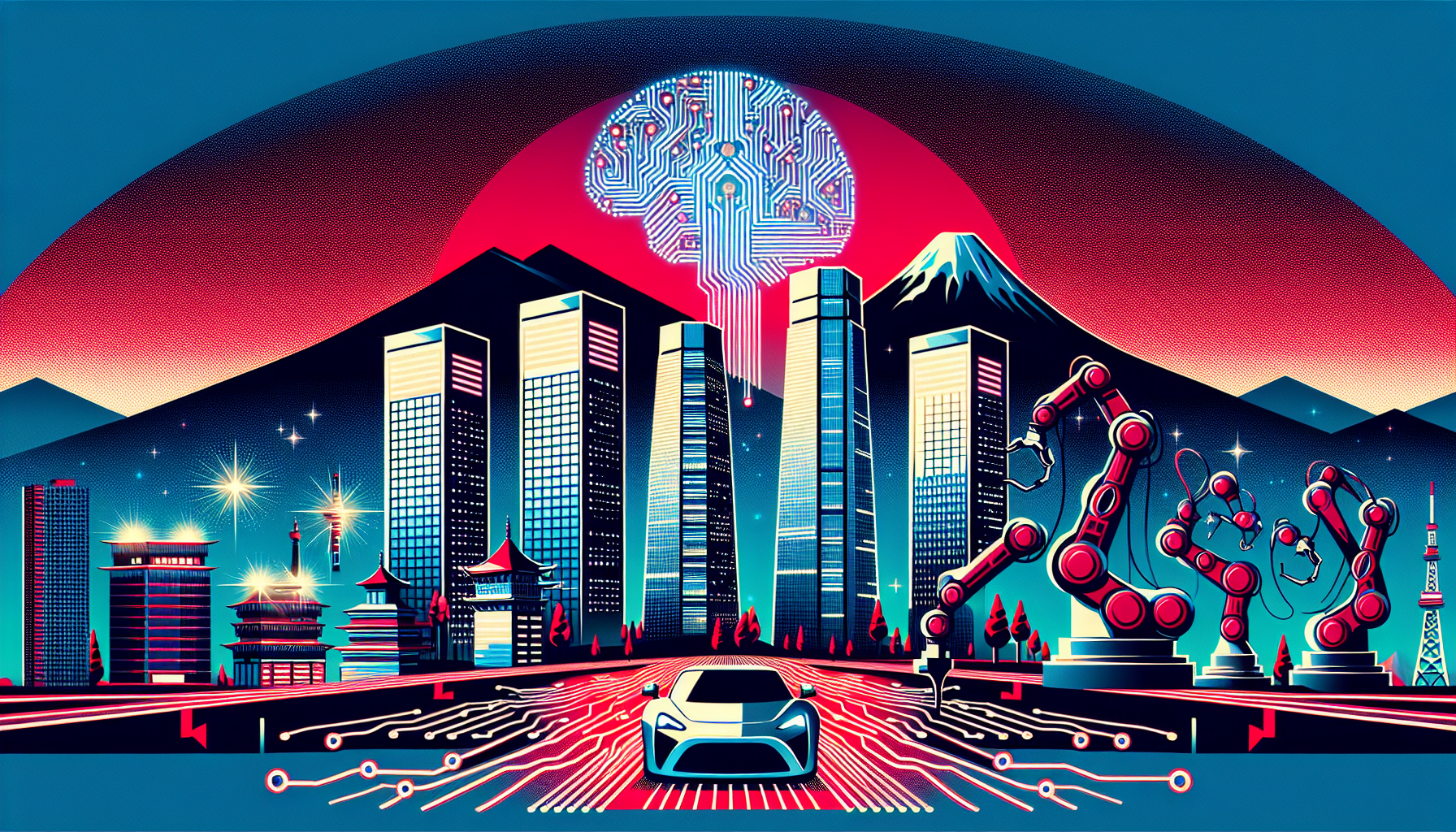
The government plans to invest approximately ¥1 trillion over five years, with the aim of creating a domestically produced AI at the 1-trillion-parameter scale and a "physical AI" that leverages the strengths of Japan's manufacturing industry.
In this article, we explain the full scope of this national-level project in an easy-to-understand way and dig into what kind of impact it will have on our lives and work.
Let's start with the basics.
According to a report by Nikkei on April 12, 2026, the new company "Japan AI Foundation Model Development" has been established to develop domestically produced AI foundation models in earnest.
A foundation model refers to a large, general-purpose AI — like ChatGPT or Claude — that can be used for a wide variety of applications.
The backbone of the company is formed by four companies: SoftBank, NEC, Honda, and Sony Group.
Each will invest around ten-plus percent and share management responsibilities.
Think of it like four powerhouse teams joining forces to create a Japanese national team — a coalition taking on OpenAI and Google, which no single company could challenge alone.
Further, the three mega-banks — Mitsubishi UFJ Bank, Sumitomo Mitsui Banking Corporation, and Mizuho Bank — along with Nippon Steel and Kobe Steel are participating as minority shareholders.
The banks are involved to provide financial support, while the steelmakers are included with the aim of gathering manufacturing industry data.
In addition, Preferred Networks (PFN), well known for AI development, is also expected to participate on the technical side.
The biggest point of focus is the scale of government support.
A support framework of approximately ¥1 trillion is set to be established over five years starting in fiscal year 2026.
Divide ¥1 trillion by five years and you get ¥200 billion per year — a sum comparable to Japan's space development budget, which can be read as a declaration of intent to elevate AI to the status of a "national policy industry."
Some people might think, "Japan is already behind — why not just use ChatGPT?" But there are three clear reasons why the government and the eight-company alliance are serious about building domestic AI.
When you use overseas AI, there is a risk that your company's confidential information and customer data could be sent to servers owned by American companies.
To use an analogy, it's like taking your private diary to a foreign post office every day.
In fields such as defense, healthcare, and finance, there is data that "absolutely cannot leave the country," and with a domestically produced AI, even such data can be used safely for training.
What would happen if tensions between the U.S. and China escalated and OpenAI or Google restricted services for Japan?
More and more business operations already can't function without AI, so it is becoming an "infrastructure that cannot be stopped" — much like electricity or oil.
Being 100% dependent on overseas sources for AI supply carries the same risk as having zero energy self-sufficiency.
Japan is home to world-class manufacturers like Toyota, Honda, Sony, and Panasonic.
The sensor data and factory operation know-how they have accumulated over decades is a treasure that even GAFAM doesn't possess.
If AI is trained on this data, you can create not just "AI that writes text," but "AI that can run a factory" — and that is the aim of this alliance.
The most important keyword in this announcement is "physical AI." It may be an unfamiliar term, but the meaning is simple.
Physical AI refers to AI that doesn't just exist on a screen but can actually operate robots and machines.
If ChatGPT is AI that excels in "the world of text," then physical AI is AI that works in "the real world."
For example, a factory assembly robot precisely assembling components under AI instruction, or a self-driving car assessing road conditions and driving safely — these are what physical AI encompasses.
Developing physical AI requires a massive amount of "data on how machines move."
Japan's manufacturing industry has been accumulating factory sensor data and vehicle driving data for over 50 years.
It's like an orchestra conductor who has years of recordings — with this data, high-quality AI can be created.
The new company envisions three application areas.
First, autonomous driving (led by Honda); second, general-purpose robots for use in factories and homes (led by Sony); and third, optimization of semiconductor design and manufacturing processes.
The era of "entrusting an entire factory to AI" could become reality within five years.
The global AI landscape is currently dominated by two superpowers: the United States and China. Let's look at how the Japan alliance plans to break into that space by comparing it to the major rivals.
The global general-purpose AI market is overwhelmingly dominated by GPT-5.2, Gemini 3.x, and Claude 4.x.
All are estimated to be at the multi-trillion-parameter scale, with U.S. big tech sprinting ahead on GPU investments in the tens of trillions of yen.
In baseball terms, they're the powerhouses of the major leagues — catching up with them is no easy feat.
In China, Qwen3 (Alibaba), ERNIE (Baidu), and DeepSeek are growing rapidly.
Through an open-source approach, they are drawing in developers from around the world and competing with U.S. players on cost.
Strong government support and abundant domestic data are their weapons.
Since going head-to-head with GPT-5 or Gemini isn't realistic, the Japan alliance is targeting the vertical market of "manufacturing specialization."
The strategy is to build a "ChatGPT for manufacturing" using factory, robot, and automotive data that GAFAM doesn't have.
To use an analogy, rather than competing with McDonald's, it's more like differentiating by positioning as a specialist in Japanese cuisine.
Japan already has several domestically produced LLMs, including SB Intuitions' "Sarashina" (460B parameters), PFN's "PLaMo 2.2 Prime," NTT's "tsuzumi 2," NEC's "cotomi v3," and KDDI/ELYZA's Japanese-language LLM.
The new company is expected to build on these existing assets and scale up dramatically toward the 1-trillion-parameter level.
"Bringing each company's fragmented research under one banner" — that is the greatest significance of this alliance.
From here, let's look at what this news means for people in specific positions.
A works at an auto parts manufacturer in Aichi Prefecture, drawing up parts blueprints every day in CAD for Honda and Nissan.
If physical AI becomes practical, A will be able to ask the AI, "Give me the optimal bracket design for this new model's engine."
A prototype design that used to take three days might be cut down to half a day — that kind of world could arrive in two to three years.
B's metal processing company in Ota, Tokyo faces a serious challenge: the aging of skilled workers.
There is a risk that veteran workers will retire before younger ones are fully trained.
If physical AI can learn the movements of skilled workers, it may be possible to pass on "veteran craftsmanship" to AI robots.
It has the potential to become a trump card that saves Japan's small factories.
C's company is developing self-driving taxis, but they're using an AI model made in the United States.
Because data must be sent to overseas cloud servers, they're struggling with permits from the Ministry of Land, Infrastructure, Transport and Tourism.
If a domestically produced physical AI becomes practical, data can be processed entirely within Japan, which would make clearing regulations significantly easier.
D is a heavy ChatGPT user who writes proposals with it every day.
D used to think, "Domestic AI has nothing to do with me," but the situation changes entirely if a client (a bank) requests, "Please create the proposal using domestic AI."
A future where domestic AI becomes essential for work in finance, healthcare, and the public sector is beginning to come into view.
Behind the brilliant plans, there is no shortage of concerns.
The announcement indicates the goal of completing a 1-trillion-parameter model in the latter half of the 2020s (around 2028–2030). Since competing models like GPT and Gemini are already estimated to be at the multi-trillion-parameter scale, there is a possibility that the Japanese model will be "one generation behind" even at completion.
While overseas players update their models every six months or so, Japan's public-private alliances tend to take longer in decision-making. There is a concern of falling into the "consensus-building trap" — similar to the decision-making struggles seen in the Nissan-Renault alliance.
The world's top AI researchers are being recruited by Google and OpenAI with annual salaries in the hundreds of millions of yen.
Even with a consolidation of around 100 people, whether cutting-edge talent can be secured is an unknown.
It becomes a "battle of budget and brand power," much like signing free-agent players in professional baseball.
Training a 1-trillion-parameter model requires tens of thousands of NVIDIA H100/B200-class GPUs. Currently, GPUs are being fought over worldwide, and it is no exaggeration to say that whether or not they can be procured will determine success or failure.
A. At the earliest, around 2027–2028 is the expectation.
Initially, B2B applications such as automobiles and factories will take priority, and general-use chat services are expected to come later.
However, there is a possibility that consumers will experience it sooner than expected in indirect forms — such as through Sony's AIBO successor robot or Honda's self-driving vehicles.
A. There is no need to switch at this point.
The new company's AI is expected to be completed and released in several years, and in the meantime, GPT and Claude are expected to maintain their advantage in text generation performance.
However, people working in finance, healthcare, or the public sector may see an increase in projects requiring domestic AI in the future, so it would be wise to keep an eye on developments.
A. This is a debate with arguments on both sides.
Proponents argue, "Depending on overseas AI will cost far more in the future" and "It is essential for maintaining the competitiveness of manufacturing."
Opponents point out, "The private sector is sufficient — government involvement leads to inefficiency" and "There is a risk of failure like next-generation Rapidus in semiconductors."
The verdict depends on the results over the next five years, but the sense of crisis — that doing nothing will almost certainly result in Japan becoming an AI backwater — is what is driving the government to act.
A. Significant indirect benefits can be expected.
If the AI developed by the four major companies is sold externally, small and medium-sized enterprises are expected to be able to use "domestic AI APIs" at low cost.
In particular, small factories, the construction industry, and logistics stand to potentially offset labor shortages through the digitalization and automation of skilled techniques.
There are also moves by the Ministry of Economy, Trade and Industry to prepare subsidy frameworks for SMEs, so keep a close eye on this.
A. Existing models are expected to be used as a foundation.
The Japanese-language processing know-how cultivated through Sarashina (460B) and PLaMo 2.2 Prime will form the basis of the new company's 1-trillion-parameter model.
Think of it as "merging each company's separate research and building an enhanced version" — the existing models won't go to waste.
A. Japanese is a uniquely complex language globally, mixing hiragana, katakana, kanji, and romaji, with complex systems of subject omission and honorifics.
Overseas AI is primarily trained on English, so it can struggle with the nuances of Japanese in certain situations.
Domestic AI will be trained thoroughly on Japanese-language data, so significantly higher accuracy is expected for business documents, medical records, and legal documents.
A. Robot AI is specialized for robot control, while physical AI is a broader concept.
Physical AI refers to AI that drives the entire range of real-world physical systems — entire factory production lines, self-driving vehicles, smart farms, building management systems, and more.
It's easiest to understand robot AI as one subset of physical AI.
While GPT-5 and Gemini dominate the world, the strategy Japan should pursue is "not a frontal assault, but a unique path in a vertical market."
Bringing together SoftBank's vision, NEC's technical capabilities, Honda's autonomous driving, Sony's robotics, and PFN's research strengths under one banner is an undertaking of a scale unseen in the past 20 years.
If it succeeds, it could save both Japan's manufacturing industry and its economic security. If it fails, it may go down in history as "an example of a failed national AI project."
For the next five years, tracking the progress of this company will serve as a barometer for Japan's future.
This article is a cross-post from AI Friends.