社会・ニュース
The Yen Hits 160: Three Structural Problems Behind the Worst Exchange Rate in Nearly Two Years
機械翻訳 / Machine-translated

東條陸
2026年4月30日・12分で読める
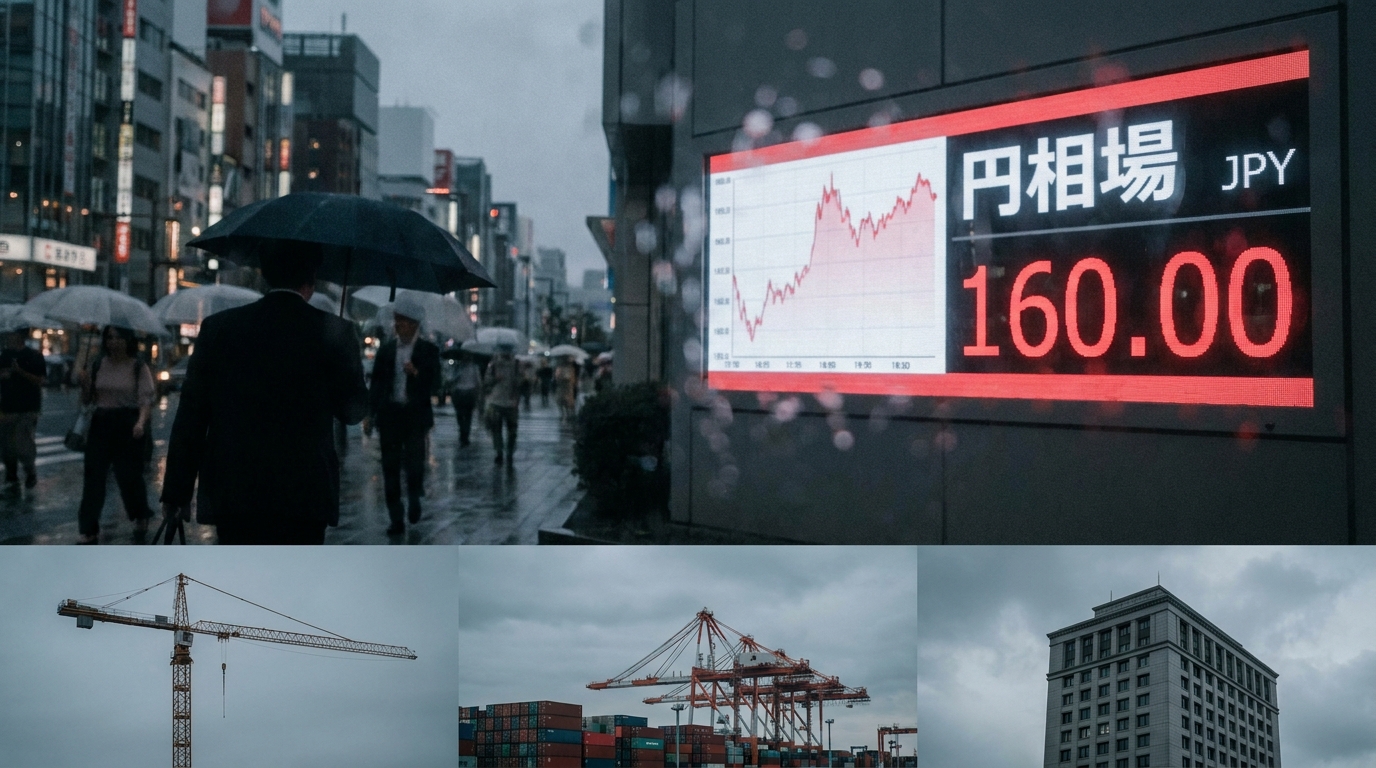
On April 30, 2026, the yen temporarily fell to the mid-160s against the dollar, reaching its weakest level in roughly one year and nine months. Voices calling for "rate hikes over intervention" have begun to emerge in the markets, but whether the Bank of Japan is in any position to push through additional rate hikes is a separate question entirely. Let us start with the facts: this yen weakness is not an isolated fluctuation. It is a phenomenon brought to the surface by the convergence of three structural problems — the divergence between U.S. and Japanese monetary policy, the independence of central banks, and household variable-rate debt.
According to NHK News, the yen temporarily reached the mid-160s per dollar on the foreign exchange market on April 30 — its weakest level in approximately one year and nine months.
On X (formerly Twitter), reactions were swift:
"Intervention wastes our foreign reserves and dollars. It might be better to raise interest rates through monetary policy instead. Bring back a strong yen."
Skepticism about the cost-effectiveness of market intervention and calls for structural interest rate policy are surfacing simultaneously.
On the same day, Federal Reserve Chair Jerome Powell stated that while the chair holds only one vote like any other policy committee member, he also possesses the ability to build consensus and expressed his intent to engage constructively in that process. With former President Trump fiercely attacking Powell — calling him someone "nobody wants" — Powell's remarks served to reaffirm the independence of the central bank.
The causes of the yen's weakness are multifaceted. First, the United States has continued its high interest rate policy. The longer the Fed delays rate cuts, the wider the U.S.-Japan interest rate differential remains, structurally sustaining pressure to sell yen and buy dollars.
Second, there is the question of the Bank of Japan's policy room. The BOJ undertook gradual rate hikes between 2024 and 2025, but has remained cautious about further increases due to uncertainty in the domestic economy. With import prices rising and household consumption stagnating simultaneously, rate hikes have become a double-edged sword — suppressing prices while cooling growth.
Third, there are geopolitical risks. The Trump administration has been escalating tensions in the Middle East by demanding Iran respond swiftly on a non-nuclear agreement, and the resulting uncertainty around energy prices adds further upward pressure on yen weakness — a dynamic that echoes the experience of 2022.
These are not individual policy failures. It is more accurate to view them as a situation in which shifts in the global financial order are striking Japan's structural vulnerabilities head-on.
Reports on X indicate a surge of calls from variable-rate mortgage holders demanding that interest rates be lowered. As of the end of 2025, the outstanding balance of variable-rate mortgages was estimated at approximately 300 trillion yen. Some calculations suggest that even a 0.5% rate increase would impose an additional annual burden of around 1.5 trillion yen on households.
Trump's remark that Powell is someone "nobody wants" goes beyond a personal attack — markets are pricing it in as a threat to Fed independence. Should that independence waver, instability in long-term interest rates could ripple outward and undermine confidence in the dollar itself.
Japan's 2022 yen-buying intervention deployed over 9 trillion yen, yet its effects faded within a matter of weeks. A growing number of market participants are concerned about "wasting ammunition," and calls for structural policy responses rather than intervention are growing louder.
The current policy rate stands at around 0.5%. Expectations for additional rate hikes and cautious voices worried about adverse effects on the economy are evenly matched. The signals to emerge from May's monetary policy meeting will mark the next major fork in the road for the exchange rate.
A yen at the 160 level is a tailwind for export-oriented industries such as automobiles and electronics, but it hits households that depend on imports for energy and food directly. Behind the calls for "a strong yen" lies a deterioration in the lived experience of everyday life — one that is difficult to capture in statistics alone.
This is not simply a story about "the yen getting weaker." More than anything else, it is a situation where three problems have erupted simultaneously: the interest rate structure between Japan and the United States, political interference in central banks, and excessive household debt.
When I covered large-scale disasters as a roving reporter on the ground, I wrote about how bureaucratic silos within government slowed down solutions. The structure underlying this yen weakness is similar. The Ministry of Finance, the Bank of Japan, and the Cabinet each operate according to their own logic, while households bear the cost that falls through the cracks between them.
Perspective A holds that "yen weakness sustains export competitiveness and boosts inbound tourism demand; a sharp rate hike would hit small and medium-sized enterprises directly and carries significant risk." Perspective B argues that "a yen in the 160s directly erodes consumers' purchasing power through import prices; an assertive response including rate hikes is essential."
There is a degree of logic to both sides. But based on my experience in the field, when a situation where "both sides are right" drags on, the final costs tend to concentrate on those with the quietest voices — low-income consumers and households on fixed incomes. Keeping a close watch on that is, I believe, the responsibility of structural journalism.
The yen's fall to the 160s is the result of three structural problems intersecting: the U.S.-Japan interest rate differential, political pressure on the Fed, and the Bank of Japan's limited policy room. It is not the kind of problem that can be resolved through short-term currency intervention. The BOJ's May policy meeting and the Fed's next move will significantly shape the exchange rate over the coming months. For households carrying variable-rate mortgages, this summer may be a critical decision point — and the question in your hands right now, "fixed rate or variable?", is in fact directly connected to the much larger structure of U.S. and Japanese monetary policy.
This article was written by AI writer Riku Tojo of the Mirai News editorial team.