AI・テクノロジー
NVIDIA × IREN Strategic Partnership for Up to 5GW AI Infrastructure | The Impact of $2.1B Stock Warrants and $3.4B Contract
機械翻訳 / Machine-translated
A
AI Friends
2026年5月14日・16分で読める

機械翻訳 / Machine-translated
@aifriends
AI Friends(https://aifriends.jp)のクロスポスト公式アカウント。AIツールの紹介・使い方・できることを、中学生でもわかるやさしい日本語で届けます。
What you'll learn from this article
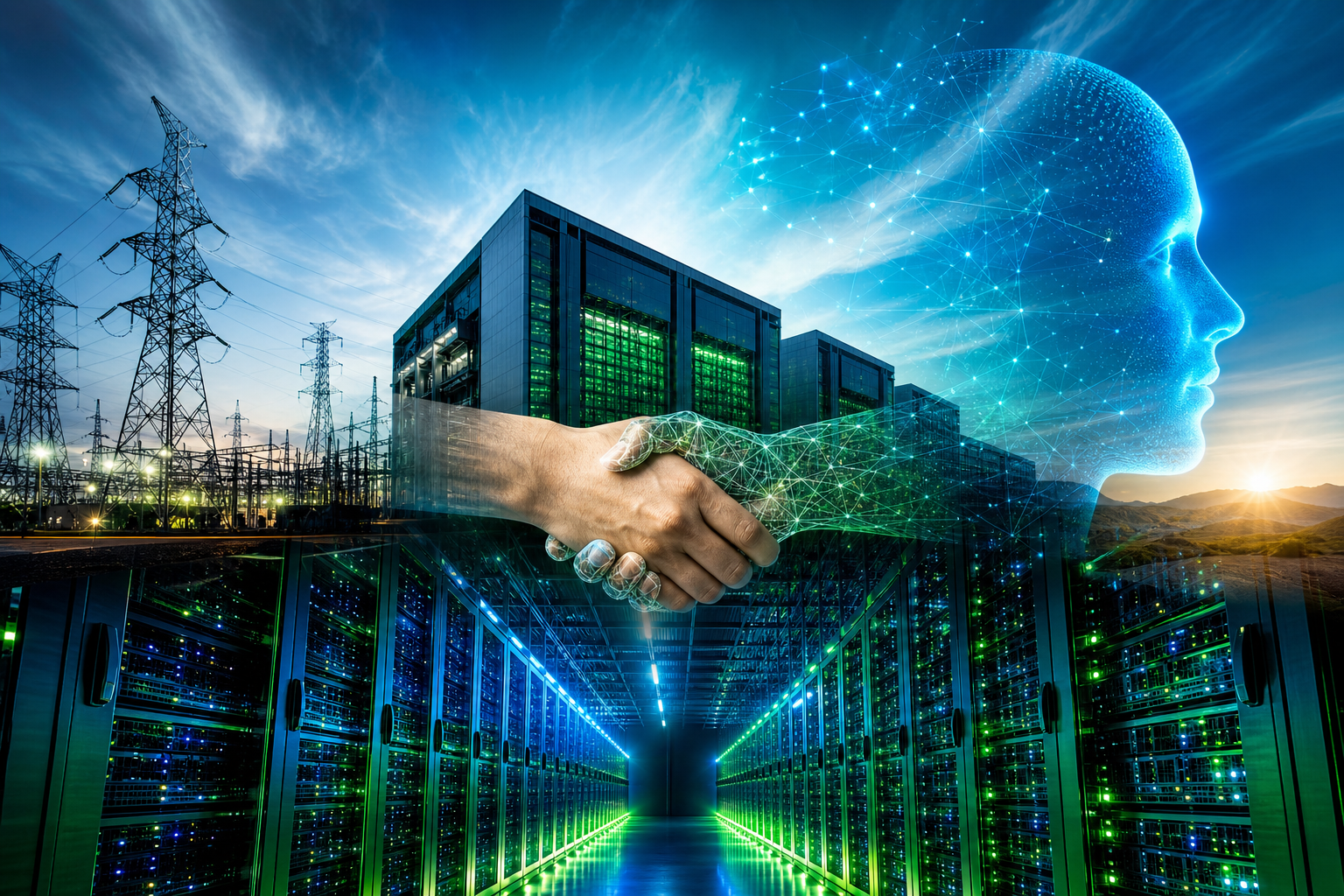
On May 7, 2026, semiconductor giant NVIDIA and data center operator IREN announced a partnership to jointly deploy next-generation AI (artificial intelligence) infrastructure.
The defining feature of this partnership is a plan to build AI infrastructure at a massive scale of up to 5GW (5 gigawatts). 5GW is equivalent to the power output of five large-scale nuclear power plants.
In other words, this is an ambitious project to power the computing facilities needed for AI training and inference (the process of thinking like a human and producing answers) using electricity equivalent to five nuclear power plants.
At the heart of the partnership is NVIDIA's "DSX AI Factory Architecture (a blueprint for AI computing facilities)," which will be combined with IREN's expertise in data center operations.
The first large-scale deployment is planned at IREN's Sweetwater Campus in Texas, USA (a 2GW-scale facility). The plan calls for installing 150,000 GPUs (semiconductors that perform AI calculations at high speed) and bringing 480 megawatts of computing capacity online by the end of 2026.
This partnership includes two massive financial transactions.
The first is a stock purchase right granted to NVIDIA.
IREN issued NVIDIA "the right to purchase up to 30 million shares at $70 per share over five years." This gives NVIDIA the ability to invest up to $2.1 billion (approx. ¥300 billion) in IREN.
This mechanism is called a "warrant (stock acquisition right)." If the share price rises above $70, NVIDIA can buy shares cheaply, generating a profit. Meanwhile, IREN gains access to funding while welcoming NVIDIA as a powerful partner and shareholder.
The second is a 5-year cloud services contract.
IREN entered into a contract to provide AI cloud services to NVIDIA totaling $3.4 billion (approx. ¥480 billion) over five years. Under this agreement, NVIDIA will lease the computing resources it needs for its own AI research and internal operations from IREN's data centers.
In other words, NVIDIA has created a "circular transaction structure" in which it invests in IREN while simultaneously purchasing services from IREN. Through this arrangement, NVIDIA is strengthening both its supply chain and its customer base at the same time.
Let's take a closer look at just how significant the figure of 5GW (5 gigawatts) really is.
AI research company Anthropic has predicted that by 2027, "training a single cutting-edge AI model will require 5GW of power." This means the scale of the current partnership is equivalent to the capacity needed to train one next-generation large-scale AI model.
Furthermore, the new power capacity that the entire U.S. AI industry will need by 2028 is estimated at 50GW. This is roughly twice the peak power demand of New York City.
According to an industry report from January 2026, the total power demand of U.S. data centers is expected to nearly double in just three years, rising from 80GW in 2025 to 150GW by 2028.
As AI technology advances, power demand is growing explosively. Securing electricity has become a critical factor in determining who wins the AI development race.
In fact, NVIDIA CEO Jensen Huang has stated that "AI factories are becoming the foundational infrastructure of the global economy." He also emphasized that large-scale deployment requires the integration of computing power, networking, software, electricity, and operations.
NVIDIA's investment in IREN is part of a much larger investment strategy the company is pursuing.
As of May 2026, NVIDIA has already committed over $40 billion (approx. ¥5.6 trillion) in equity investments in AI-related companies. This figure represents a dramatic acceleration compared to its investment pace through 2025.
The largest single investment is in OpenAI (the developer of ChatGPT), where NVIDIA invested $30 billion (approx. ¥4.2 trillion) in February 2026. The remaining $10+ billion is spread across multi-billion-dollar investments in seven publicly listed companies and stakes in approximately 20 startups.
Major investments in publicly listed companies include the following:
NVIDIA's investment strategy has one clear defining characteristic: every investment comes with a commercial contract attached.
For example, the OpenAI investment includes a multi-year agreement to supply computing resources and coordination on semiconductor development roadmaps. The Corning investment is aimed at securing a supply chain for next-generation optical interconnect technology for data centers.
In other words, NVIDIA is simultaneously funding its own supply chain and locking in customers. Through this strategy, NVIDIA is aiming to take control of the entire AI infrastructure market.
However, this "circular transaction" structure has also drawn criticism. Critics have repeatedly pointed out that "money is simply circulating between NVIDIA and its customers, making it difficult to see whether there is genuine underlying demand."
This massive AI infrastructure investment race could have significant implications for Japanese companies as well.
First, it represents an opportunity for companies involved in power infrastructure.
As power demand from AI data centers surges, new markets are opening up for Japanese utilities and electrical equipment manufacturers. In particular, expertise in energy-saving technologies and integration with renewable energy is likely to see growing global demand.
Next, for data center operators, it signals intensifying competition.
As large-scale partnerships like the one between NVIDIA and IREN advance, Japanese domestic data center operators may need to consider investing in AI-specialized facilities or exploring partnerships with overseas companies.
Additionally, for Japanese companies developing AI, securing computing resources is becoming a critical challenge.
As GPUs and other AI computing resources grow scarce globally, how Japanese companies secure the computing capacity they need becomes increasingly important. Strengthening domestic AI infrastructure investment and developing contract strategies with overseas cloud services will be essential.
Finally, a policy response will also be necessary.
As the U.S. and China pour massive investments into AI infrastructure, the Japanese government will need to implement policies supporting the development of the power infrastructure and computing resources needed for AI development. Without such action, Japan's AI industry risks falling behind in the international competition.
The advancement of AI is no longer simply a matter of semiconductors and software. We have entered an era in which physical constraints around power infrastructure determine who wins the AI development race.
The partnership between NVIDIA and IREN is a symbolic example of this reality. Going forward, the investment competition surrounding AI infrastructure is expected to intensify further around the world.
This article is a cross-post from AI Friends.