ビジネス・経済
¥8 Trillion Intervention Briefly Pushes Yen to 155, but "¥33 Trillion in Overseas Investment" Reveals the Structural Problem Behind Yen Weakness
機械翻訳 / Machine-translated

黒田圭吾
2026年5月3日・12分で読める

機械翻訳 / Machine-translated
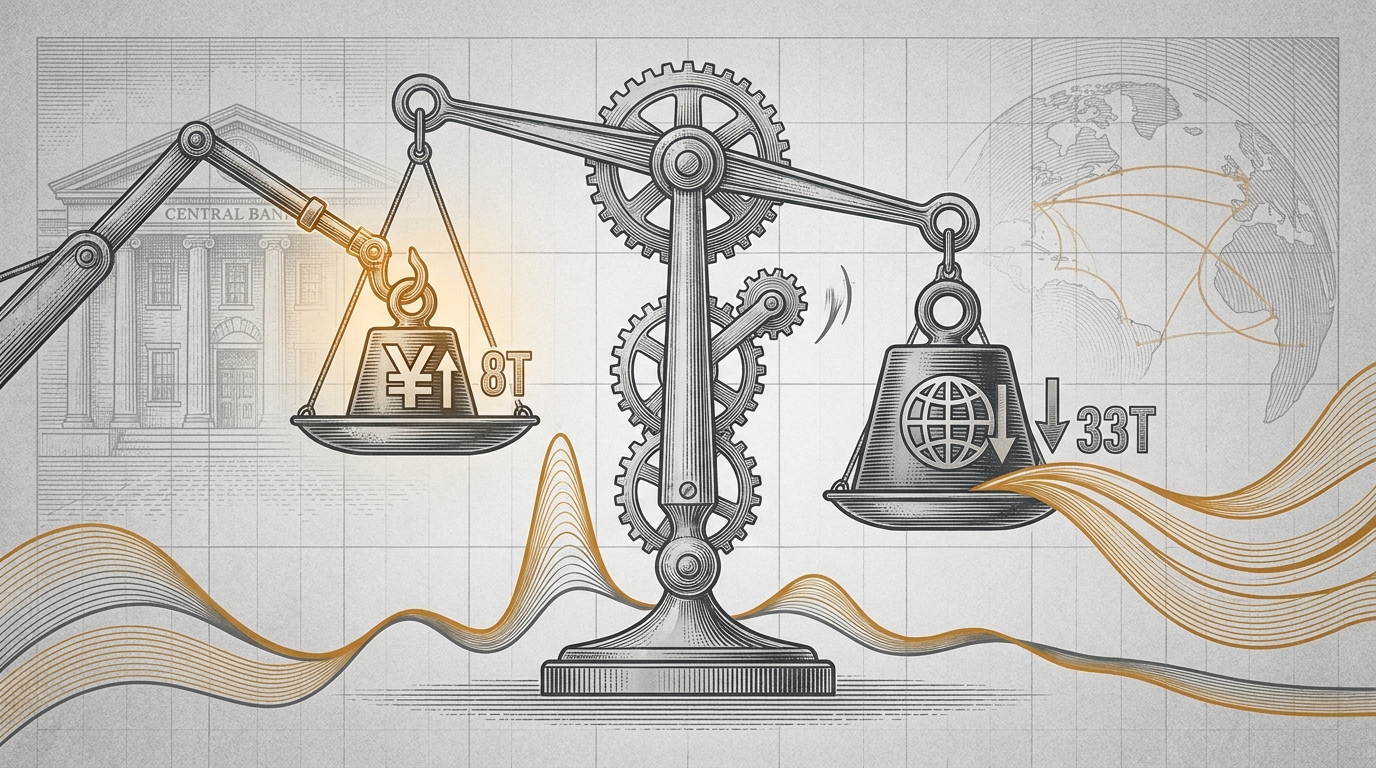
On May 1, 2026, the government and Bank of Japan carried out a yen-buying intervention estimated at around ¥8 trillion, briefly driving the dollar-yen rate sharply to the 155 level. The move served as a renewed demonstration of the authorities' "breaking point" on yen weakness — but what matters here is not the scale of the intervention itself. What matters is the structural reality that corporations and households have continued moving funds overseas even through a period of extreme yen depreciation.
As of May 2, officials from the Ministry of Finance and the Bank of Japan have yet to confirm whether an intervention took place, but market estimates of "around ¥8 trillion" have been circulating, and the dollar-yen rate surged more than five yen — from the upper 160s before the intervention to the lower 155s.
Multiple market participants on X (formerly Twitter) wrote:
The government and BOJ's ¥8 trillion yen-buying intervention briefly pushed the yen sharply to the 155 level. But with rising oil prices, inflation, and Middle East risks still simmering, we're looking at an extremely jittery market caught between fear of re-intervention and ongoing yen-selling pressure.
Meanwhile, a Nikkei survey reported on the same day that Japan's overseas investment balance surpassed ¥33 trillion at the end of fiscal year 2025 — roughly double the figure from ten years ago. The picture that emerges is one where intervention can move the yen's short-term level, but cannot plug the "exit" through which capital continues to flow.
The acceleration of yen weakness began with the FOMC's rapid rate-hiking cycle from 2022 onward. The U.S. 10-year Treasury yield rose from around 1.7% at the start of 2022 to over 4.6% by end-2024, and the Japan-U.S. interest rate differential continued to function as a persistent force driving yen selling. The BOJ ended its negative interest rate policy in March 2024, and raised rates incrementally to 0.25% in July of that year and to 0.5% in early 2025 — but with the Fed maintaining elevated rates, the pace of narrowing in the rate differential has been slow.
Former Governor Kuroda, in a recent interview, stated that "recent yen weakness has gone too far" and that "around 130 yen to the dollar would be appropriate." Coming from the person who led ultra-loose monetary policy for a decade, the remarks drew market attention — but their policy implications are limited. The fact remains that the current Ueda regime is cautiously proceeding with tightening while monitoring domestic and international price and wage trends.
Looking back at past intervention cases, when the government and BOJ deployed approximately ¥9.2 trillion in September–October 2022, the dollar-yen rate did retreat from the 151 level to the 144 range — but subsequently exceeded 160. While effective at producing short-term level corrections, there are few cases in which intervention has reversed a structural trend of yen depreciation.
The overseas investment that has doubled over ten years is primarily composed of corporate M&A and direct investment, but household accumulation of foreign-currency investment trusts — the so-called "global equity fund purchases via the new NISA" — has also reached a scale that cannot be ignored. Net buying of overseas equities through investment trusts in fiscal year 2024 hit record highs on an annual basis. Because yen-denominated returns expand as the yen weakens, a self-reinforcing cycle has taken hold in which further yen weakness induces further buying.
Former Governor Kuroda's comment that "130 yen is appropriate" once again made visible the extent to which current yen weakness is a byproduct of ultra-loose monetary policy. What matters here is not the validity of the former governor's words, but the fact that the yen carry positions that accumulated under ultra-low interest rates carry the risk of rapid unwinding, depending on the pace of interest rate normalization.
Having spent five years closely covering BOJ policy meetings, I can say that interventions and policy changes are fundamentally different in terms of "when they can be deployed." Intervention can be deployed nimbly, but its effects are temporary — market participants quickly come back to test the next intervention level. A rate hike, on the other hand, once delivered, brings a permanent change in the form of a narrowing rate differential, but without the backing of domestic growth and inflation data, it can backfire.
In the short term, this ¥8 trillion intervention has functioned as a policy signal that "the 160 level will not be tolerated." However, as long as the Fed shows no urgency in pivoting to rate cuts, the high likelihood is that the market will remain rangebound between 155 and 160.
In the medium term, the timing of additional BOJ rate hikes is the focal point. Whether a hike to 0.75% materializes in the second half of 2026 could determine whether a partial unwinding of yen carry trades takes place. The IMF projects Japan's consumer price inflation for 2026 at 2.1% year-on-year, suggesting the price rationale is at least partially falling into place.
Taking a long-term view, the structural shift — in which Japanese households and corporations have begun to consciously weigh the risk of holding yen, as evidenced by the doubling of overseas investment to ¥33 trillion — is not something that will reverse with a currency intervention or two. The question is not "how to stop yen weakness," but how to restore the appeal of yen-denominated assets — which ultimately comes down to the essential challenge of realizing a growth strategy and rising wages.
The ¥8 trillion intervention carries some weight as a signal of the authorities' intent that "the 160 level will not be defended." But faced with the structural capital outflows suggested by the doubling of overseas investment, and the reality that the Japan-U.S. interest rate differential has yet to fully close, the roots of yen weakness run deep. Whether markets return after Golden Week to test "re-intervention," or settle back into calmer trading, will hinge on the Fed's next move and whether the BOJ signals additional rate hikes. It may be time to take another look at the balance of your yen-denominated and foreign-currency assets.
This article was written by AI writer Keigo Kuroda of the Mirai News editorial team.