ビジネス・経済AI補助
What to Do When Crowdfunding Support Stalls | 7 Things to Revisit at the Midpoint
機械翻訳 / Machine-translated
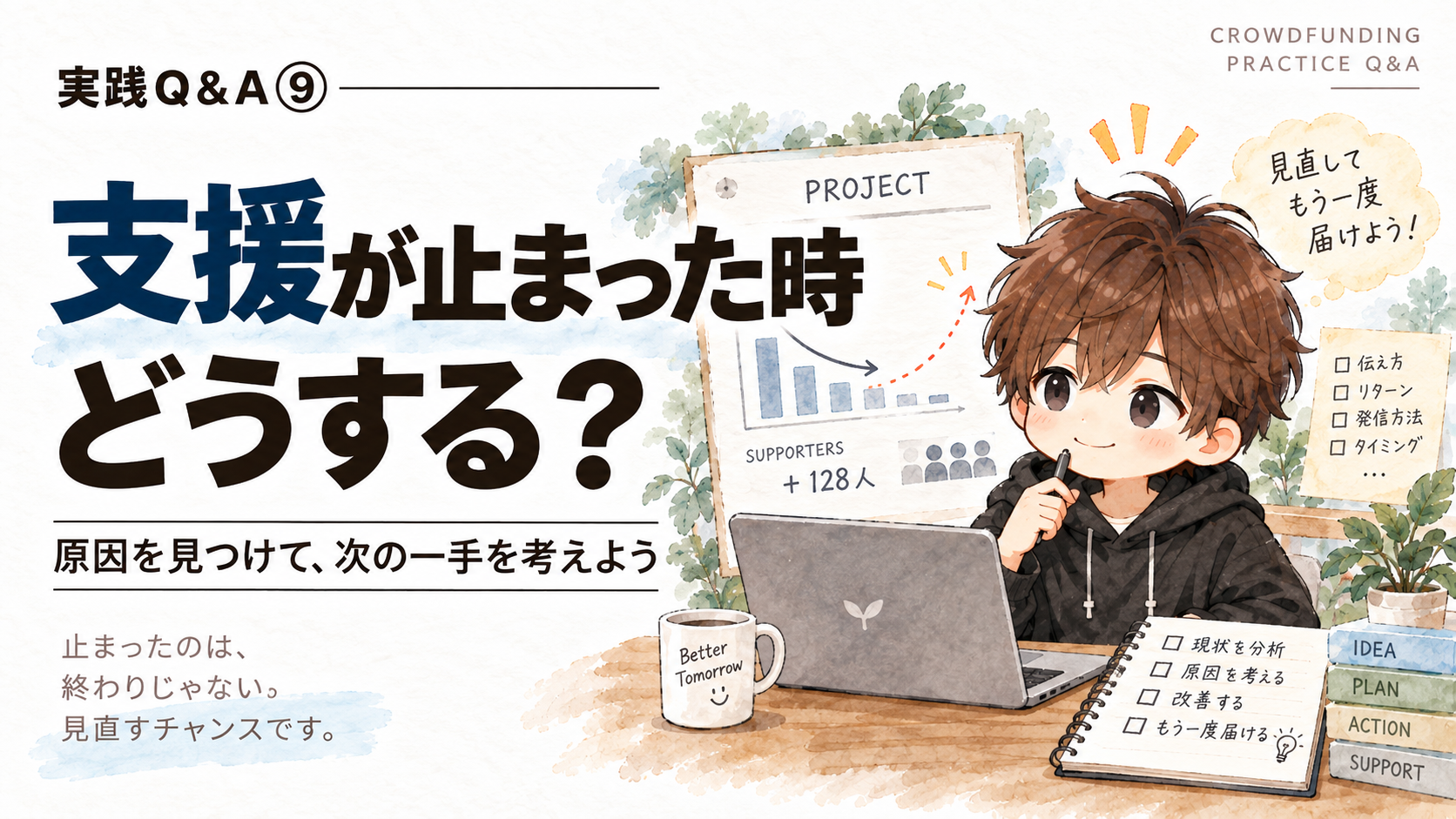
"Support came in at first, but then it suddenly stopped."
If you've run a crowdfunding campaign, you may have experienced this.
Backing came in right after launch.
There was a response on social media too.
But after a few days, support barely moves at all.
That's when anxiety sets in, and you start thinking:
"I need to post more on social media."
"I have to ask people every day to please support me."
But my view is this:
When support stalls, the most important thing is to step back and assess the situation — before simply increasing how much you post.
Crowdfunding campaigns naturally have a mid-period lull where backing tends to quiet down compared to right after launch and right before the deadline.
Having watched many projects over the years, I can say:
A mid-campaign slump itself is not unusual.
The real problem isn't that support has stopped.
It's continuing to do the same thing without changing anything.
When the momentum from launch day fades, you might think:
"Is this campaign already done for?"
But as long as there's still time left in your campaign period, there are still things you can do.
CAMPFIRE's own data shows that projects that consistently post activity reports tend to have higher goal-attainment rates.
That said, it's not as simple as:
"Write activity reports and more backing will come."
What matters is:
Keeping your project moving even after it goes live.
A crowdfunding campaign isn't finished the moment it launches.
You watch how people respond after launch, and you revisit:
When support stops, the first thing I ask myself is:
Where exactly is it stalling?
Is the project simply not being discovered in the first place?
Is the page being viewed, but not converting to support?
Are the rewards hard to choose from?
Has it reached existing customers but not spread beyond them?
Are people interested but lacking a reason to back it right now?
The next step depends on the cause.
So rather than:
Support stalls
↓
Post more on social media
I think through it this way:
Support stalls
↓
Why did it stall?
↓
Change the next move
The first thing I do is confirm:
What actually happened from the moment the campaign launched?
And conversely — who were the people you expected to act, but didn't?
For example:
If existing customers backed you quite generously — then you need to expand beyond that circle next.
If social media gets reactions but no backing — your page or rewards may need revisiting.
If only the higher-priced rewards aren't moving — the issue may not be the price itself, but rather a weak reason to back at that amount.
In other words:
The first week is both a period for gathering support and a period for checking your answers.
When support stalls, it's easy to fall into posting nothing but:
"Only ○ days left!"
"We haven't reached our goal yet!"
"Please cheer us on!"
But when that's all people see, they become numb to it.
Instead, I share things like:
I tell the story of the project from different angles.
Even for the same campaign, different people connect through different entry points.
That's why social media outreach for crowdfunding isn't about repeating "please support us" over and over — it's about:
Creating more touchpoints that make people want to cheer you on.
I go into this in more detail in "Crowdfunding Social Media Strategy | You Can't Raise Support With Just 'Please Back Us'".
CAMPFIRE has an activity report feature.
Activity reports aren't just a diary.
They're a place to tell:
That your project is still moving forward.
Rather than just writing "we've reached ○% today," I include:
When support has stalled, what matters most is:
Showing a project that's in motion — not just a number that's standing still.
People who have already backed you haven't finished their role the moment they contributed.
They can still:
That's why I don't just stop at "Thank you for your support" —
I also specifically tell backers how they can continue to support the project.
For example:
"I'd love for these kinds of people to hear about this."
"If this resonates with you, please share it."
A backer isn't just someone who gave money once.
They have the potential to become a participant who helps spread the project alongside you.
That's how I see it.
Once a campaign is live, feedback can emerge that you couldn't have anticipated beforehand:
"I just want one."
"I'd love a set for the whole family."
"I'd join if there were an experience like this."
"Is there a plan for businesses?"
If you hear things like this:
Adding new rewards is an option worth considering.
However, this isn't about:
"Support has stalled, so let's just add something — anything."
Instead, ask:
Additional rewards aren't about padding out the numbers —
They're for creating new ways for people to participate.
That's what matters.
What makes the mid-campaign period difficult is that:
It's no longer as fresh as the launch,
but there's not yet the urgency of the final deadline.
That's why I think about:
Creating new news during the middle stretch.
This could include:
As I've written before:
Reaching 100% isn't the finish line — it's material for the next round of outreach.
SNS followers who didn't react when the campaign first launched may well comment "Congratulations!" on a post announcing "We hit 100%!"
Those comments and shares can then reach people who had never heard of the project before.
That's why, throughout the campaign period, I also prioritize:
Creating moments worth talking about next.
No matter how many times you post on social media, there are people who simply aren't seeing it.
So when support stalls, I also revisit personal outreach.
That said, it's not about sending the same person repeated messages asking:
"Will you back me yet?"
With consideration for the relationship:
Reach the right people, at the right time, in a genuine way.
That's what I keep in mind.
I believe every crowdfunding campaign has a lull in the middle.
In the three-week framework I've mentioned before, each week plays a different role:
The middle stretch isn't just a period where support naturally dips.
It's a time to review the first week and lay the groundwork for the final week.
These are the questions to sit with.
That's why I don't try to eliminate the mid-campaign lull entirely.
What matters more is:
How you use that lull.
This is really important.
When I consult with people about crowdfunding, a comment that sometimes comes up is:
"If I'm listed on CAMPFIRE, won't CAMPFIRE's own users see it too?"
That's not to say zero people will discover your project through CAMPFIRE and back it.
But I don't:
Design a campaign on the assumption that CAMPFIRE will handle promotion on our behalf.
CAMPFIRE is a platform for listing projects and receiving support.
What we need to think through ourselves is:
That's something the project owner has to build.
So when the numbers stall:
Don't wait, thinking "someone will stumble across it eventually."
That's what needs to move.
Crowdfunding is not something you:
Set up a page for and then wait.
When I'm feeling anxious, I won't:
And I won't:
Wait around thinking "I'm on CAMPFIRE, so people will come around eventually."
When the numbers stop:
Rather than repeating the same actions,
Change what you're doing.
That's where it starts.
Even when you do everything you can, there are times when support just doesn't grow the way you hoped.
In those moments, what matters isn't searching for convenient excuses, but:
Seeing the current numbers for what they are.
What you discover through this lens is valuable not just for this campaign —
It's firsthand information you can use in your products and business going forward.
Crowdfunding is a means of raising funds, but it's also:
A place where the market gives you answers.
If support doesn't come the way you hoped,
the question is: what do you take from that?
I think of that as part of crowdfunding too.
When someone asks me: "Support for my crowdfunding campaign has stopped. What should I do?"
My first answer is:
Don't panic and repeat the same things.
Then prepare for the final week.
When support stalls, what you need isn't simply to keep saying:
"Please support us."
It's looking at what you've done so far and changing your next move.
A crowdfunding campaign isn't something you launch and then run on the same strategy through to the end.
I think of it as:
A project you keep improving, watching how people respond, even after it goes live.
So when the numbers stop:
Rather than getting stuck on "Why aren't people backing this?"
Try asking yourself:
"What should I change next?"
What to Do on Day One of Your Crowdfunding Launch | What to Do for a Strong Start
Crowdfunding Social Media Strategy | You Can't Raise Support With Just "Please Back Us"
7 Common Ways Crowdfunding Campaigns Fail | Points to Check Before You Launch
If you'd like to consult about crowdfunding, please check my profile page.